

Point of View
Digital transformation initiatives often fail not because of technology, but because leadership expectations do not match the true demands of the work. Organizations frequently apply the same language, governance, and project management approach to fundamentally different types of change. This article introduces a practical framework for classifying initiatives based on total complexity and organizational disruption, helping leaders distinguish between Optimize, Modernize, Rewire, and Transform efforts. By aligning leadership involvement and project management rigor with the nature of the work, senior teams can reduce risk, improve adoption, and increase the likelihood of sustained outcomes.
Digital transformation is a term used broadly across organizations. In practice, however, not all technology-enabled initiatives are transformational—and treating them as if they are often leads to avoidable failure.
Across product, strategy, and operational initiatives, one pattern appears consistently: organizations apply the same language, expectations, and project management approach to fundamentally different types of change. Some initiatives primarily require disciplined execution and delivery management. Others require sustained leadership engagement and a clear, shared vision for how the organization will operate once the work is complete.
The failure mode is rarely effort or intent.
It is a misclassification.
When leadership expectations do not match the true demands of the work, friction emerges—often long before anyone can clearly articulate why.
Two Questions That Clarify Digital and Organizational Change
Instead of asking whether an initiative is “strategic” or “large,” leadership teams benefit from asking two more diagnostic questions.
The first is the overall complexity of the work. Total complexity extends beyond technology to include systems, integrations, data dependencies, vendor coordination, cross-functional sequencing, governance requirements, and execution risk. This dimension determines how difficult the work is to deliver and what level of project management rigor and structural oversight is required.
The second is how much the work will change how people operate day to day. Organizational disruption reflects changes in behavior, operating models, workflows, decision rights, incentives, and accountability. This dimension determines whether success depends primarily on execution or on sustained executive leadership and reinforcement after implementation.
These dimensions often move independently. Some initiatives are highly complex yet minimally disruptive to the business’s operations. Others appear straightforward yet fundamentally alter how teams work together.
When these forces are separated, predictable patterns emerge.
Four Types of Digital Transformation and Change Initiatives
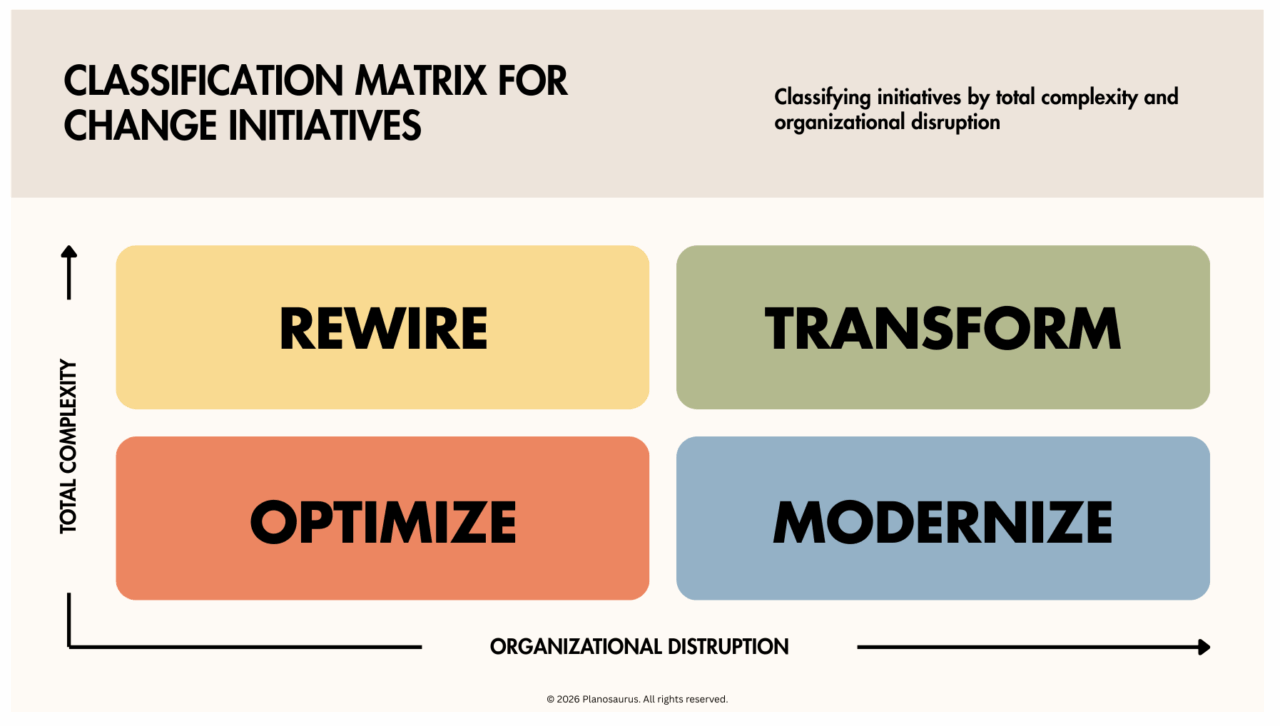
By combining total complexity and organizational disruption, most digital transformation and organizational change initiatives fall into four categories.
Optimize initiatives improve efficiency within the existing operating model and primarily require clear ownership and disciplined execution. Modernize initiatives involve high complexity while preserving how the business operates, requiring strong technical and operational clarity. Rewire initiatives change how people work through relatively simple interventions and depend on active executive sponsorship and behavioral reinforcement. Transform initiatives alter both enabling systems and the operating model itself and require sustained executive leadership and a clear end-state vision.
This framework is not a maturity model. It is a classification tool designed to align leadership posture, governance structure, and project management formality with the true demands of the work.
The In-Between: Why Digital Initiatives Drift
In reality, initiatives do not remain static. Many begin in one category and gradually migrate toward another as scope, scale, or impact expands.
A local improvement becomes an enterprise dependency. A tool rollout alters decision rights. A pilot evolves into a platform.
The work may not feel more complex, but it becomes fundamentally different.
This transitional space—the “in-between”—is where change management and leadership alignment most frequently break down. Leadership effort increases, yet governance structures and expectations remain unchanged. Delivery teams often recognize the shift before it is formally acknowledged.
A practical leadership checkpoint is simple. If the initiative were starting today, would it be led the same way? If the answer is no, the initiative has likely crossed into a new category and requires recalibration of both leadership involvement and project management structure.
Aligning Leadership, Governance, and Execution
Effective digital transformation depends on matching leadership involvement and execution structure to the nature of the work.
Total complexity determines how difficult the initiative is to deliver. Organizational disruption determines whether change will be adopted and sustained. Leadership determines whether there is a clear, credible vision for how the organization should function once the initiative is complete.
Applying heavy governance to low-complexity initiatives can unnecessarily slow progress. Applying lightweight coordination to high-complexity efforts increases delivery risk. Expecting project management discipline alone to compensate for unclear leadership direction rarely produces lasting change.
In practice, leadership matters most not because it accelerates execution, but because it clarifies destination. Without a stable, shared understanding of the intended future state, even well-managed transformation efforts struggle to deliver measurable outcomes.
Implications for Senior Leadership Teams
For leaders operating at the intersection of product, strategy, and operations, accurately classifying initiatives provides a strategic advantage. It informs how governance is designed, how executive time is allocated, how portfolios are prioritized, and how risk is managed.
Not every initiative requires transformational leadership.
But those who do cannot succeed without it.
Clarity at the outset—and periodic reassessment as the work evolves—reduces organizational friction, improves alignment, and increases the likelihood that change will endure.
How This Connects to Execution
Misclassification is rarely just a delivery issue. It reflects a broader gap in how organizations connect strategy, decision-making, execution, and performance.
Organizations that consistently translate strategy into outcomes operate with defined systems across market strategy, strategic governance, execution coordination, and performance intelligence. These systems ensure that initiatives are properly classified, resourced, and managed according to their true demands.
Without this structure, even well-intentioned transformation efforts drift—because leadership, governance, and execution are not aligned.
Evaluate Your Strategy
Most organizations believe their strategy is clear. Few have a way to validate it.
The Market Strategy Diagnostic provides a quick, structured way to assess how clearly your strategy is defined—and how consistently it is applied.