

Decide What Gets Done—and What Doesn’t
The system for prioritizing, approving, and coordinating initiatives to ensure execution aligns with strategy and drives measurable market share growth.
The Problem
Without a structured approach to prioritization and governance, execution becomes fragmented and difficult to sustain.
Most organizations do not lack ideas—they lack a way to prioritize them.
In practice, initiatives are often:
- Driven by urgency rather than strategy
- Influenced by internal stakeholders rather than clear priorities
- Approved without a consistent evaluation framework
This leads to:
- Too many initiatives competing for resources
- Leadership attention spread across conflicting priorities
- Frequent shifts in direction and focus
- Investment decisions that are not consistently aligned with market opportunity or strategic goals
The Solution
Investment decisions that are not consistently aligned with market opportunity or strategic goals.
Strategic Governance establishes a clear, consistent approach to how initiatives are evaluated, prioritized, and approved.
It is a structured, facilitated process that defines:
- How initiatives are assessed against strategy
- How tradeoffs are evaluated across competing priorities
- How decisions are made and communicated
- How initiatives are coordinated across leadership teams
Through this process, organizations establish a governance model that produces clear, usable outputs, including:
- Defined prioritization criteria and scoring models
- A structured initiative intake and evaluation process
- A prioritized initiative portfolio aligned to strategy
- A governance cadence for reviewing and adjusting priorities
The Control Layer of the Execution System
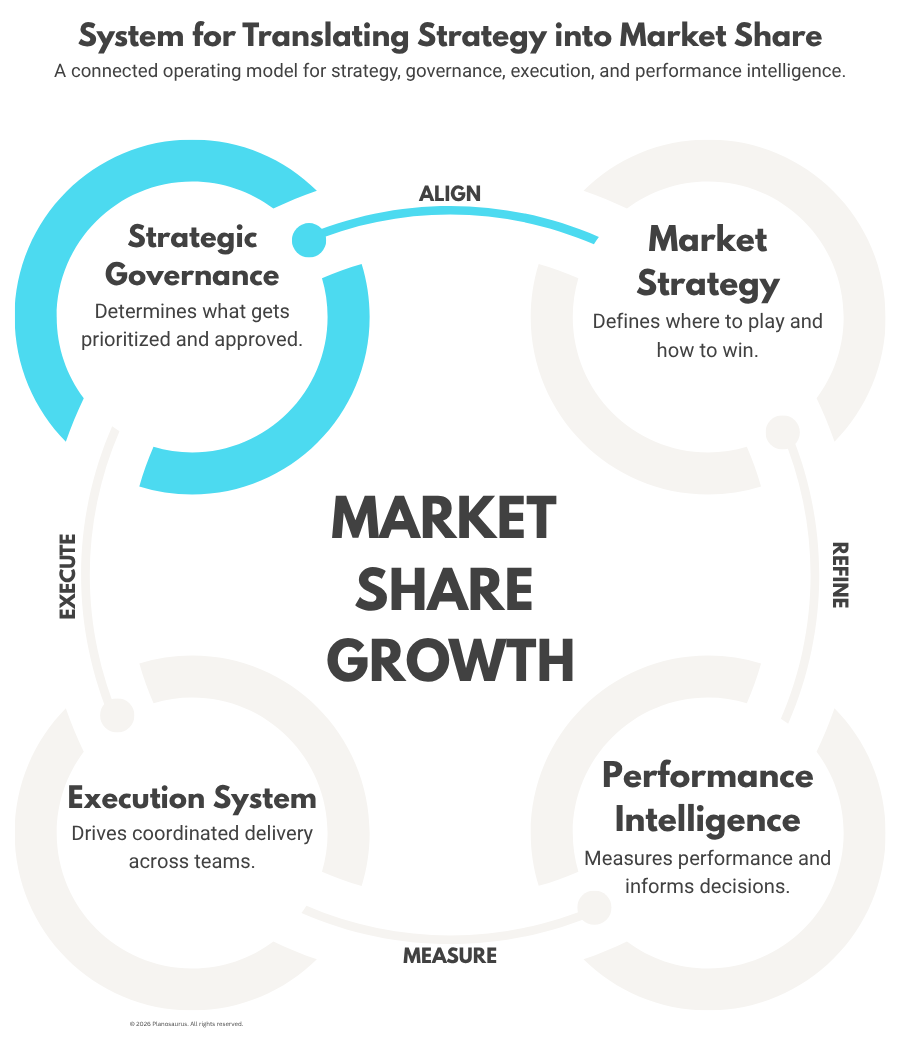
Most organizations attempt to improve execution without fixing decision-making—resulting in overload, misalignment, and limited impact.
Strategic Governance connects strategy to execution by determining what gets prioritized and approved.
Without a structured governance model, organizations cannot consistently translate strategy into action.
This service ensures that:
- Strategy is reflected in investment decisions
- Initiatives are aligned to defined priorities
- Tradeoffs are made explicitly, not implicitly
What Gets Defined
These elements ensure that decisions are consistent, transparent, and aligned to strategic priorities.
The core elements required to consistently prioritize and coordinate initiatives:
Prioritization Framework
A structured approach for evaluating initiatives based on strategic alignment, impact, and feasibility.
Initiative Intake Process
A clear process for submitting, evaluating, and approving new initiatives.
Decision Criteria & Scoring Models
Defined criteria used to compare and prioritize competing initiatives.
Initiative Portfolio
A prioritized view of active and planned initiatives aligned to strategy.
Governance Cadence
A structured rhythm for reviewing progress, reprioritizing, and making decisions.
Business Impact
Execution becomes intentional—driven by clear priorities rather than competing demands.
When governance is clearly defined and operationalized:
Low Priority
Fewer, higher-impact initiatives are pursued
Resources
Resources are allocated more effectively across priorities
Alignment
Leadership alignment improves around key decisions
Decisions
Tradeoffs are made explicitly and consistently
Execution
Execution becomes more focused and less reactive
Investments
Investment decisions are better aligned with strategy and market opportunity
How It Works
Outcome: A strategy that is not only defined, but consistently applied across the organization.
Diagnostic & Blueprint
Outcome: A clear governance model and prioritized roadmap for improving decision-making.
A structured evaluation of how initiatives are currently prioritized, approved, and managed.
This includes:
- Assessment of current governance practices
- Identification of gaps in prioritization and decision-making
- Definition of a future-state governance model to improve maturity
- Prioritized recommendations for implementation
The focus is not on arbitrarily reducing initiatives, but on creating clarity and consistency in decision-making.
Implementation & Support
Outcome: A governance system that is actively used to guide decisions and align execution.
Support in implementing the governance model defined in Phase 1.
This may include:
- Designing prioritization frameworks and scoring models
- Establishing initiative intake and approval processes
- Implementing governance cadences and leadership forums
- Aligning teams to new decision-making processes
- Integrating governance into planning and execution workflows
Engagements are tailored based on organizational needs and priorities.
Start with a Structured Assessment
Most organizations believe their strategy is clear. Few have a simple way to validate it.
In just a few minutes, you’ll get:
- A view of your current maturity
- Insight into where gaps exist
- A clearer understanding of what may be limiting execution