

Ensure Strategy Gets Executed—Consistently
The system for structuring, coordinating, and delivering initiatives across teams to ensure execution aligns with strategy and drives measurable market share growth.
The Problem
Without a structured execution system, even well-defined strategies and priorities fail to translate into results.
Most organizations do not struggle to start initiatives—they struggle to execute them consistently.
In practice, execution is often:
- Fragmented across teams and functions
- Dependent on individuals rather than structured processes
- Lacking clear ownership and coordination
This leads to:
- Initiatives progressing unevenly or stalling
- Misalignment across sales, marketing, product, and operations
- Limited visibility into execution status and outcomes
- Inconsistent delivery against strategic priorities despite significant effort and investment
The Solution
The result is an execution model that is consistent, scalable, and aligned to strategic priorities.
The Execution System establishes a structured, coordinated approach to delivering initiatives across the organization.
The Execution System establishes a structured, coordinated approach to delivering initiatives across the organization.
- How initiatives are organized and structured
- How work is coordinated across teams and functions
- How ownership and accountability are established
- How progress is tracked and managed
Through this process, organizations create a consistent execution model supported by clear, usable outputs, including:
- Standardized initiative structures and workflows
- Defined roles, ownership, and accountability models
- Cross-functional coordination mechanisms
- Clear tracking and reporting structures
The Delivery Layer of the Execution System
Most organizations attempt to improve performance without fixing execution—resulting in inconsistency, inefficiency, and missed outcomes.
The Execution System is responsible for delivering the initiatives defined through strategy and governance.
Without a structured execution model, organizations cannot consistently translate prioritized initiatives into outcomes.
This service ensures that:
- Initiatives are executed in a coordinated and repeatable way
- Teams operate from a shared structure and expectations
- Progress is visible and managed across functions
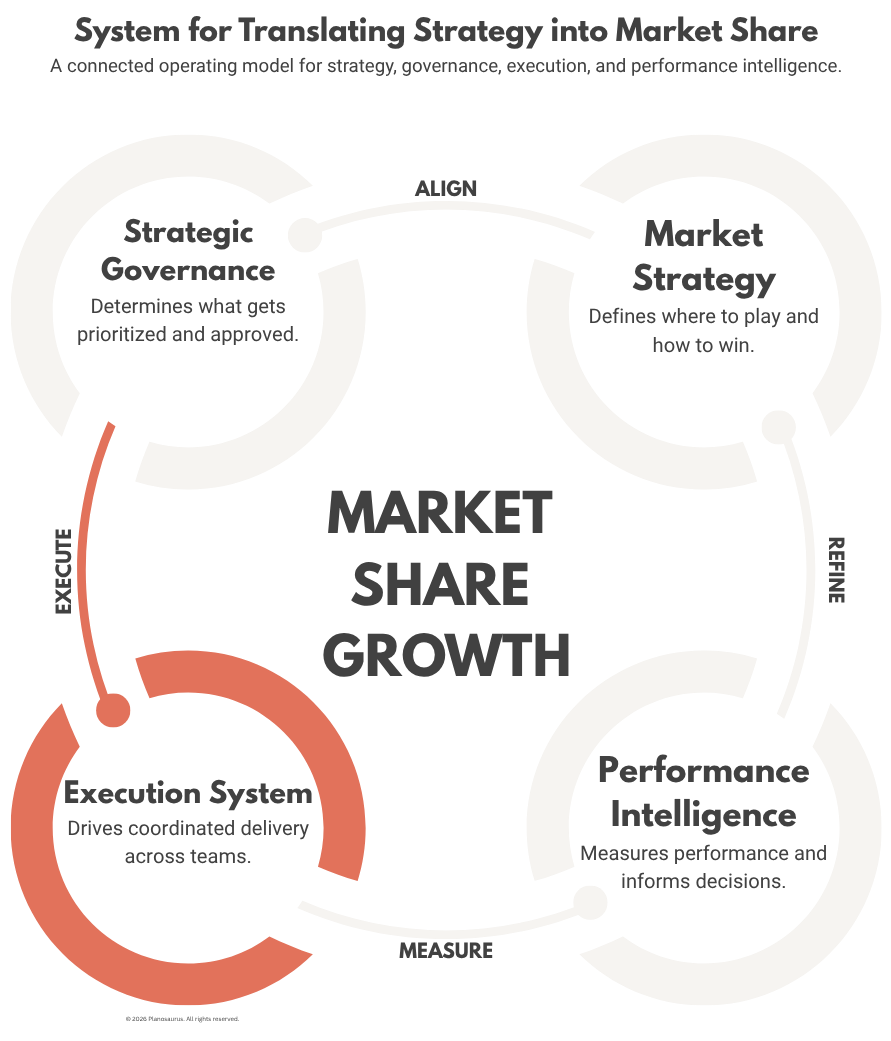
What Gets Defined
These elements ensure that execution is coordinated, visible, and consistently aligned to priorities.
These elements ensure that execution is coordinated, visible, and consistently aligned to priorities.
Initiative Structure & Workflow
A standardized approach to how initiatives are defined, planned, and executed.
Roles & Accountability Model
Clear ownership across teams, including responsibility for delivery and outcomes.
Cross-Functional Coordination
Mechanisms for aligning work across sales, marketing, product, and operations.
Execution Tracking & Visibility
Structured tracking of initiative progress, milestones, and outcomes.
Operating Cadence
A defined rhythm for managing execution, including check-ins, reviews, and adjustments.
Business Impact
Execution becomes coordinated, scalable, and consistently aligned to strategy.
When execution is clearly defined and operationalized:
Delivery
Initiatives are delivered more consistently and with fewer delays
Cross-functional
Cross-functional alignment improves across teams
Visibility
Leadership gains visibility into progress and outcomes
Systems
Execution becomes less dependent on individuals and more system-driven
Resources
Strategic priorities are more reliably translated into results
Expectations
Revenue expectations become more aligned with actual market opportunity and execution capacity
How It Works
A structured approach to improving how initiatives are delivered across teams
Diagnostic & Blueprint
Outcome: A clear execution model and prioritized roadmap for improving delivery.
A structured evaluation of how initiatives are currently executed across the organization.
This includes:
- Assessment of execution structures and workflows
- Identification of gaps in coordination, ownership, and visibility
- Definition of a future-state execution model to improve maturity
- Prioritized recommendations for implementation
The focus is not on adding more process, but on creating structure and clarity that improves consistency and coordination.
Implementation & Support
Outcome: A structured execution system that is actively used to deliver initiatives consistently.
Support in implementing the execution model defined in Phase 1.
This may include:
- Designing initiative structures and workflows
- Defining roles and accountability models
- Establishing coordination mechanisms across teams
- Implementing tracking and reporting systems
- Embedding execution practices into planning and operations
Engagements are tailored based on priorities and internal capabilities.
Start with a Structured Assessment
Most organizations believe their strategy is clear. Few have a simple way to validate it.
In just a few minutes, you’ll get:
- A view of your current maturity
- Insight into where gaps exist
- A clearer understanding of what may be limiting execution