

Define Where You Will Win
The system for defining markets, customers, and priorities that align execution and drive measurable market share growth
The Problem
Without a clearly defined market and customer strategy, execution becomes reactive—and resources are spread instead of focused.
Most organizations believe they have a strategy.
In practice, strategy is often:
- Broadly defined
- Inconsistently understood
- Not connected to execution
This leads to:
- Salespeople pursue available opportunities instead of ideal ones
- Marketing targeting broadly instead of precisely
- Product reacting to demand instead of guiding it
- Revenue expectations that are misaligned with actual market opportunity and execution capacity
The Solution
The result is a strategy that is clearly defined, consistently understood, and directly executable.
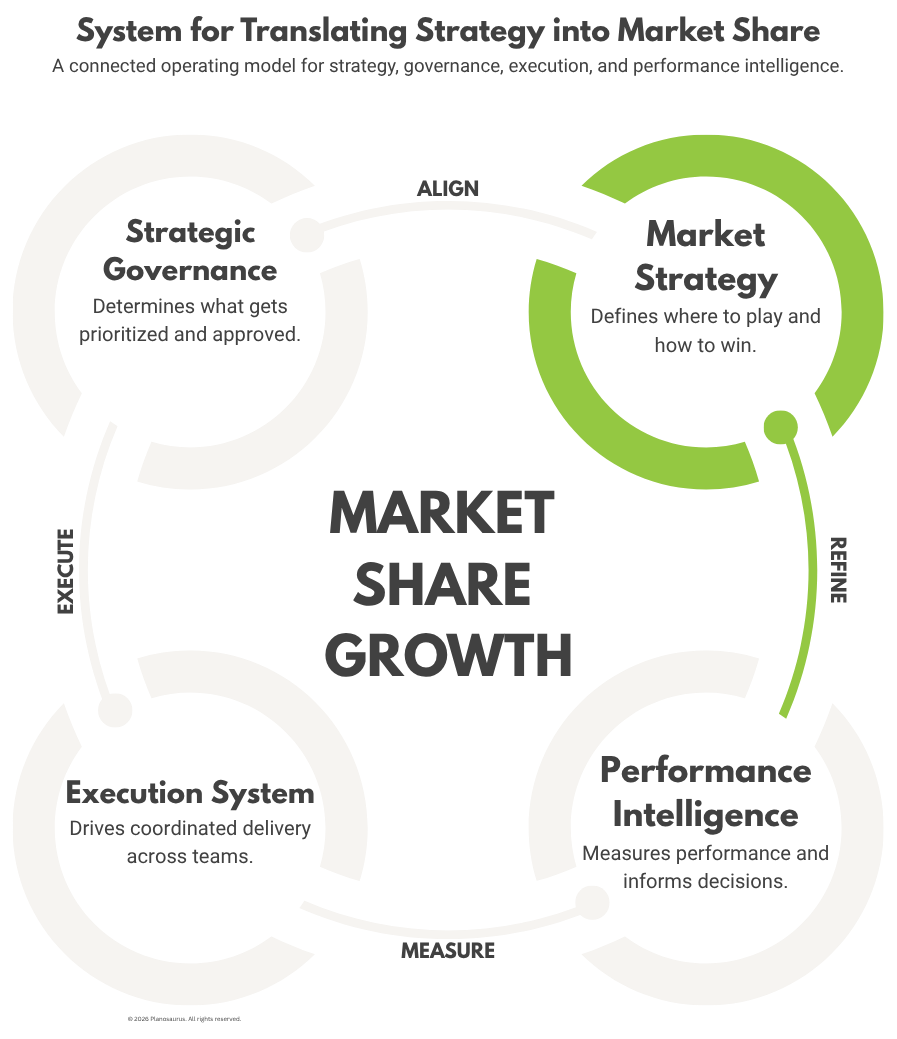
Market Strategy Definition is the first step in a broader system that translates strategy into market share growth. It defines the foundation.
Without a clear definition of markets, customers, and priorities, organizations cannot effectively:
- Prioritize initiatives
- Coordinate execution
- Measure performance
This service establishes the clarity required for the rest of the system to function. From this foundation:
- Strategic Governance ensures initiatives align to defined priorities
- Execution System enables coordinated delivery across teams
- Performance Intelligence measures outcomes and informs decisions
The Foundation of a Complete Execution System
Most organizations attempt to improve execution before establishing this foundation—resulting in misalignment, inefficiency, and limited impact.
Market Strategy Definition is the first step in a broader system that translates strategy into market share growth. It defines the foundation.
Without a clear definition of markets, customers, and priorities, organizations cannot effectively prioritize initiatives, coordinate execution, or measure performance.
This service establishes the clarity required for the rest of the system to function.
What Gets Defined
These elements create the foundation required for governance, execution, and performance intelligence to operate effectively.
These elements create the foundation required for governance, execution, and performance intelligence to operate effectively.
Market Definition
A clear view of where the organization will compete, with consistent segmentation used across planning, targeting, and reporting.
Ideal Customer Profile (ICP)
A defined set of high-value customers, with explicit inclusion and exclusion criteria grounded in performance data.
Customer Problems & Value Alignment
A clear understanding of the problems solved by segment and role, informing product direction, messaging, and sales approach.
Market Prioritization
A structured view of where to focus—and where not to—based on opportunity, fit, and execution capacity.
Data & Intelligence Foundation
The data required to support segmentation, targeting, and decision-making, including account-level visibility and performance measurement.
Business Impact
The data required to support segmentation, targeting, and decision-making, including account-level visibility and performance measurement
When market strategy is clearly defined and operationalized:
Pipeline
Pipeline quality improves, with greater concentration in high-value segments
Resources
Resources are focused on opportunities with the highest return potential
Alignment
Sales, marketing, and product align around shared priorities
Decisions
Decision-making becomes faster, more consistent, and grounded in data
Performance
Performance becomes measurable at the segment and account level, enabling more informed investment decisions
Expectations
Revenue expectations become more aligned with actual market opportunity and execution capacity
How It Works
A structured approach to clarifying your strategy and making it usable in execution.
Diagnostic & Blueprint
Outcome: A clear, prioritized blueprint for improving how your strategy is defined and applied.
A structured evaluation of how clearly your market and customer strategy is defined—and how consistently it is applied.
This includes:
- Maturity assessment (Clarity vs Discipline)
- Gap identification across key dimensions
- Prioritized recommendations
- A defined future-state model outlining how to improve maturity
The focus is not on redefining your strategy, but on making it clear, consistent, and executable.
Implementation & Support
Outcome: A strategy that is not only defined but consistently applied across the organization.
Support in implementing recommendations identified in Phase 1.
This may include:
- Refining and formalizing your ICP and segmentation
- Establishing market prioritization frameworks
- Aligning sales, marketing, and product around defined segments
- Building data structures to support targeting and measurement
- Integrating strategy into planning and workflows
Engagements are tailored based on priorities and internal capabilities.
Start with a Structured Assessment
Most organizations believe their strategy is clear. Few have a simple way to validate it.
In just a few minutes, you’ll get:
- A view of your current maturity
- Insight into where gaps exist
- A clearer understanding of what may be limiting execution