

Point of View
Expansion initiatives fail not because vision is flawed, but because discipline is insufficient. Organizations often pursue growth without rigorously validating market readiness, demonstrated economic pull, staged investment sequencing, and explicit protection of the core revenue engine. When leadership teams bypass structured challenge and hard conversations—especially when ideas originate at the top—risk compounds quickly. Sustainable expansion requires governance, measurable validation before escalation, and clear alignment between strategy, resource allocation, and outcomes.
Expansion strategies fail more often because of weak discipline than bad ideas. Organizations pursue growth with conviction, but without structured challenge, validated market readiness, or sequenced investment, even promising initiatives can destabilize performance. When ambition outpaces governance, strategy drifts away from measurable outcomes—and the cost is often borne by the core business that funds the effort.
When Ambition Outpaces Discipline
Early in my career, I worked at a profitable custom software firm in Northern California serving major food brands. The business was strong. Enterprise projects were in demand. Revenue was stable.
Then the dot-com boom arrived.
The company raised venture capital to build a digital ordering platform designed to modernize the industry. The strategic thesis was directionally correct. In fact, versions of that model thrive today.
But we skipped something essential.
We did not rigorously test readiness.
We did not validate timing.
We did not stage investment against measurable traction.
And we did not explicitly protect the core revenue engine funding the bet.
Capital and executive attention shifted quickly. The existing business slowed. The new initiative generated little to no revenue because the market was not ready to adopt at scale.
Within eighteen months, the company was gone.
The failure was not technological.
It was governance.
The Real Failure Pattern in Expansion
Across industries, expansion initiatives fail for remarkably consistent reasons.
Not because leaders lack intelligence.
Not because teams lack capability.
But because organizations fail to enforce disciplined planning when enthusiasm is high, especially when ideas originate at the top.
When expansion bypasses structured challenge, market timing assumptions go untested, economic pull is inferred rather than validated, and the stability of the core business is quietly compromised. Strategy becomes aspiration rather than outcome-driven planning.
The Two Variables That Must Be Made Explicit
Before committing meaningful resources to expansion, leadership teams must explicitly answer two questions.
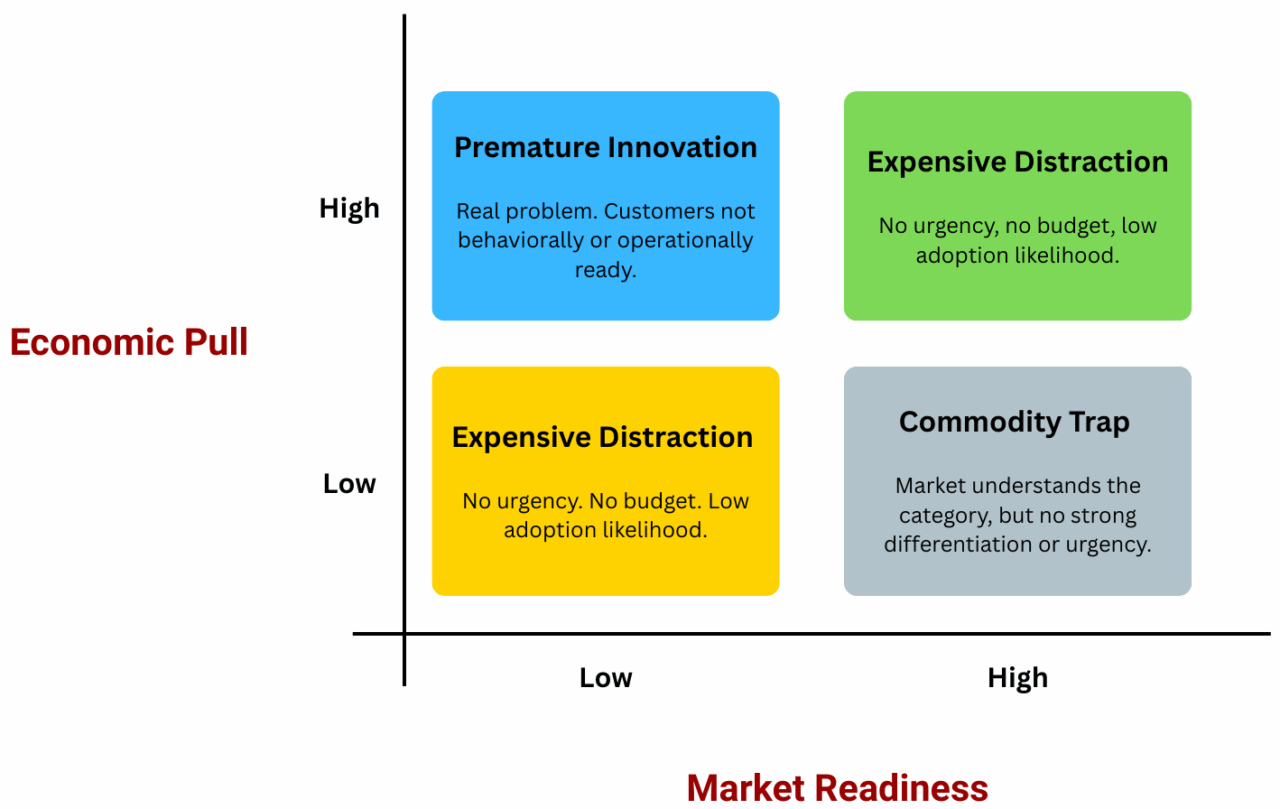
The first is whether the market is ready now. This requires evidence that customers are behaviorally prepared to adopt, that structural conditions have shifted, and that demand is present rather than anticipated. Inevitability does not equal immediacy.
The second is whether there is demonstrated economic pull. This requires proof that customers are already allocating budget to solve the problem, that price tolerance has been validated, and that willingness to pay is real. Interest is not revenue, and pilots are not proof.
When either variable is assumed rather than validated, expansion risk increases materially.
How to Run the Hard Conversation
Ambitious ideas deserve scrutiny equal to their scale.
Organizations that consistently translate strategy into outcomes create structured friction before committing capital. They separate vision from timing by requiring evidence of readiness and identifying what must be true for adoption to scale. They validate economic pull by grounding assumptions in actual spending behavior and measurable demand signals. They define gated investment triggers so that escalation follows evidence rather than optimism. They explicitly protect the core business by setting clear thresholds that cannot be compromised. And they institutionalize constructive dissent by ensuring that challenge is expected, documented, and valued.
This is not resistance to growth.
It is discipline in how growth is pursued.
Linking Strategy to Outcomes Requires Discipline
Expansion is not inherently destabilizing.
Unsequenced expansion is.
Organizations that consistently translate strategy into measurable outcomes require evidence before escalation, stage capital deployment, and protect performance while pursuing transformation. Vision creates opportunity.
Discipline determines survival.
How This Connects to Execution
These challenges are not isolated. They reflect a broader issue: the absence of a structured system that connects strategy to execution.
Organizations that consistently translate strategy into outcomes operate with defined systems across market strategy, strategic governance, execution coordination, and performance intelligence. Without these elements working together, even well-intentioned expansion efforts struggle to produce sustained results.
Final Perspective
The stock options I received during that dot-com expansion are worth nothing.
The lesson, however, has shaped every strategic evaluation since.
Big ideas deserve structured challenge.
Especially when they come from the top.
Strategy becomes performance only when assumptions are tested, sequencing is intentional, and hard conversations occur before resources move.
That is how expansion becomes sustainable—rather than fatal.