

Point of View
Most B2B strategies do not fail because they are wrong. They fail because they are not translated into a system that can guide decisions, execution, and performance over time. Organizations invest heavily in defining strategy, but far less in ensuring that it is clearly understood, consistently applied, and operationalized across the business. Without that structure, strategy becomes disconnected from execution—and growth becomes inconsistent, reactive, and difficult to sustain.
Strategy is often treated as a moment in time. Execution is treated as something separate. Growth requires both to operate as a system.
Across organizations, the pattern is consistent. Leadership teams define a strategy, communicate priorities, and initiate work across the business. But as initiatives expand across teams and functions, alignment begins to erode. Decisions are made in isolation. Execution diverges. Performance becomes difficult to interpret.
The issue is not intent. It is structure.
Where Strategies Break Down
Strategies most often fail in the transition from definition to execution. The breakdown typically appears in four ways.
- Strategy is not clearly defined at the level required for execution. Markets are broadly described. Ideal customers are loosely understood. Priorities are implied rather than explicit. Teams interpret direction differently, and alignment weakens over time.
- Decisions are not consistently aligned with strategy. Organizations lack a structured way to evaluate initiatives, make tradeoffs, and allocate resources. As a result, priorities shift based on urgency, influence, or short-term pressure rather than long-term direction.
- Execution is not coordinated across teams. Initiatives are launched, but ownership, structure, and coordination vary. Cross-functional work becomes difficult to manage, and progress becomes uneven.
- Performance is not measured in a way that informs decisions. Data exists, but it is fragmented, inconsistent, or disconnected from strategy. Leaders lack a clear view of what is working and what is not.
Each of these gaps is manageable in isolation. Together, they prevent strategy from translating into growth.
The Missing Link Is a System
Organizations that consistently translate strategy into measurable growth operate differently.
They do not rely solely on strategy. They operate with a system that connects:
- Where to compete
- What to prioritize
- How work is executed
- How performance is measured
These elements are not independent. They are interdependent.
When they are aligned, strategy becomes actionable. Execution becomes coordinated. Performance becomes measurable. Growth becomes more predictable.
When they are not, strategy becomes disconnected from reality.
The Four Capabilities Required for Growth
A practical way to understand this system is through four connected capabilities. Each capability addresses a different part of the problem. Together, they form a closed-loop system.
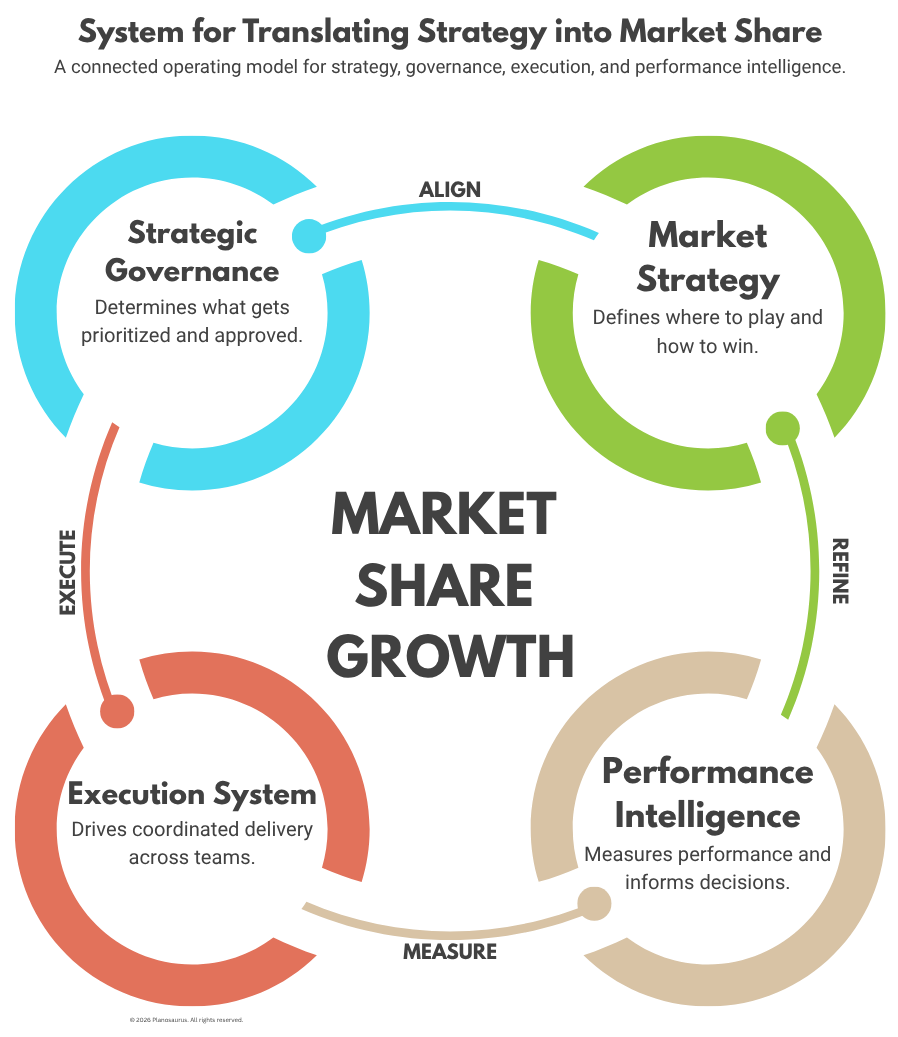
Market Strategy defines where the organization will compete and how it will win. It clarifies target markets, ideal customers, and priorities at a level that can guide execution.
Strategic Governance determines what gets prioritized and approved. It creates a structured approach to evaluating initiatives, making tradeoffs, and aligning resources to strategy.
Execution Systems ensure that work is delivered in a coordinated and consistent way. They define how initiatives are structured, managed, and aligned across teams.
Performance Intelligence measures outcomes and informs decisions. It connects data to strategy, enabling leaders to understand what is working and where adjustments are required.
Why Most Organizations Don’t Build This System
The absence of this system is rarely intentional. It is the result of how organizations evolve. Strategy is developed first. Execution structures emerge over time. Governance is introduced reactively. Data systems are layered to meet reporting needs. Each element is built independently. Integration never fully occurs.
As complexity increases, the gaps between these elements widen. What worked at a smaller scale becomes insufficient. Coordination becomes more difficult. Decision-making slows. Execution becomes inconsistent.
At that point, organizations often attempt to fix individual parts of the problem.
- They refine strategy.
- They add governance processes.
- They invest in tools.
But without connecting these elements into a system, the underlying issue remains.
What Changes When the System Is in Place
When these four capabilities operate together, the organization functions differently.
- Strategy is clearly defined and consistently understood.
- Decisions are aligned to priorities and made within a structured framework.
- Execution is coordinated across teams, with clear ownership and visibility.
- Performance is measured in a way that informs decisions and enables continuous improvement.
The result is not just better execution. It is a different operating environment. One where strategy translates into measurable outcomes more reliably over time.
How This Applies in Practice
This system is not theoretical. It shows up in how leadership teams operate day to day. It is visible in how initiatives are evaluated, how resources are allocated, how teams coordinate work, and how performance is reviewed. It reduces the need for constant realignment. It increases consistency without slowing down execution. And it creates a foundation for scaling growth without increasing chaos.
Evaluate Your Strategy
Most organizations believe their strategy is clear. Few have a way to validate it.
The Market Strategy Diagnostic provides a quick, structured way to assess how clearly your strategy is defined—and how consistently it is applied.