

Know What’s Working—and What to Do Next
The system for measuring performance, generating insight, and guiding decisions to continuously improve execution and drive measurable market share growth.
The Problem
Without a structured approach to performance intelligence, organizations cannot effectively guide execution or improve outcomes.
Most organizations have access to data—but lack the ability to use it effectively.
In practice, performance measurement is often:
- Fragmented across systems and teams
- Focused on activity rather than outcomes
- Not aligned to strategy or priorities
This leads to:
- Limited visibility into what is actually working
- Decisions based on incomplete or inconsistent information
- Difficulty linking execution to results
- Revenue and performance expectations that are not grounded in reliable, segment-level insight
The Solution
The result is a system that connects data to decisions—enabling continuous improvement and more predictable outcomes.
Performance Intelligence establishes a structured, coordinated approach to measuring performance and informing decisions.
It is a structured, facilitated process that defines:
- What should be measured and why
- How performance is tracked across segments, accounts, and initiatives
- How data is translated into usable insight
- How insights are used to guide decisions and adjustments
Through this process, organizations create a performance intelligence layer supported by clear, usable outputs, including:
- Defined performance metrics aligned to strategy and priorities
- Segment- and account-level performance visibility
- Integrated data views across sales, marketing, and product
- Structured reporting and decision-support frameworks
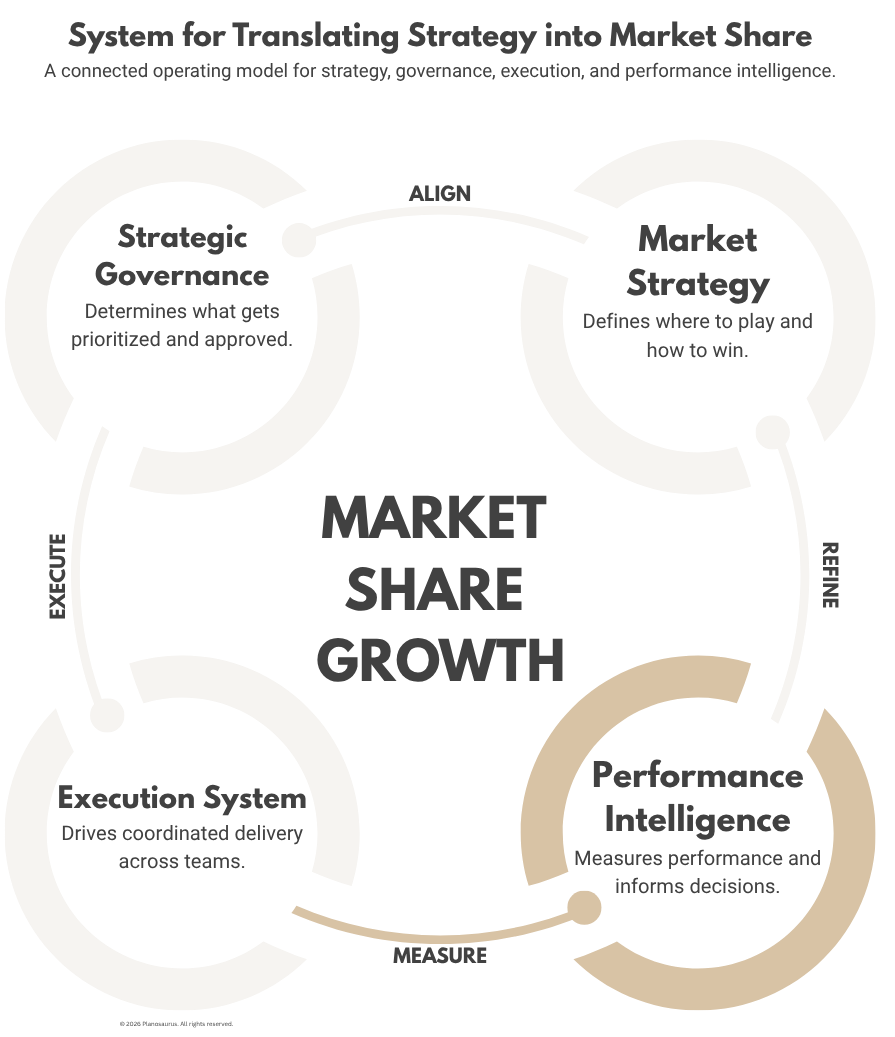
The Feedback Layer of the Execution System
Most organizations collect data but do not operationalize it—resulting in limited insight and slower improvement.
Performance Intelligence closes the loop by measuring outcomes and informing decisions across the system.
Without a structured intelligence layer, organizations cannot determine whether strategy and execution are working or how to adjust.
This service ensures that:
- Performance is visible and measurable across segments and initiatives
- Insights are consistently used to guide decisions
- Execution is continuously refined based on results
What Gets Defined
These elements ensure that data is not just collected—but actively used to guide decisions and improve outcomes.
The core elements required to measure performance and guide decisions effectively:
Performance Framework
A defined set of metrics aligned to strategy, segments, and priorities.
Segment & Account-Level Visibility
Clear performance tracking by market segment and target accounts.
Data Integration & Structure
Alignment of data across systems to support consistent reporting and analysis.
Reporting & Insight Frameworks
Structured views that translate data into actionable insight.
Decision Support & Feedback Loops
Mechanisms for using performance data to inform prioritization and execution adjustments.
Business Impact
Data becomes actionable—and execution becomes continuously optimized.
When performance intelligence is clearly defined and operationalized:
Visibility
Leaders gain visibility into what is working—and what is not
Grounded
Decisions are grounded in consistent, reliable data
Measured
Performance can be measured at the segment and account level
Decisions
Execution improves through continuous feedback and adjustment
Resources
Resources are reallocated more effectively based on results
Revenue
Revenue outcomes become more predictable and aligned to actual performance
How It Works
A structured approach to measuring performance and using data to guide decisions
Diagnostic & Blueprint
Outcome: A clear performance intelligence model and roadmap for improving visibility and decision-making.
A structured evaluation of how performance is currently measured and used to guide decisions.
This includes:
- Assessment of current metrics, reporting, and data structures
- Identification of gaps in visibility, consistency, and usability
- Definition of a future-state intelligence model to improve maturity
- Prioritized recommendations for implementation
The focus is not on adding more data, but on making existing data usable and actionable.
Implementation & Support
Outcome: A performance intelligence system that is actively used to guide decisions and improve outcomes.
Support in implementing the intelligence model defined in Phase 1.
This may include:
- Defining and aligning performance metrics
- Structuring segment- and account-level reporting
- Integrating data across systems
- Designing reporting dashboards and insight frameworks
- Embedding data into decision-making processes
Engagements are tailored based on organizational needs and priorities.
Start with a Structured Assessment
Most organizations believe their strategy is clear. Few have a simple way to validate it.
In just a few minutes, you’ll get:
- A view of your current maturity
- Insight into where gaps exist
- A clearer understanding of what may be limiting execution