
How we think
Smart change starts
with intent.
Organizations that keep evolving rarely need to reinvent themselves. Here’s what we believe, and how it shapes every engagement.
Belief 01
Transformation is usually a symptom.
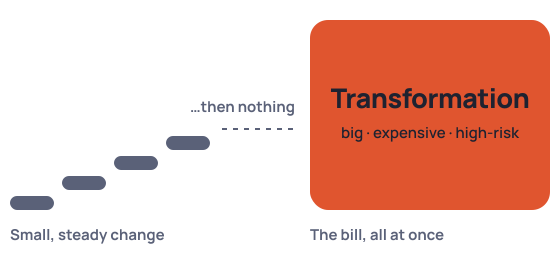
Size, cost and executive attention don’t make something transformational. What does is a model that can no longer be fixed one part at a time, usually because it went too long without maintenance. Keep evolving, and transformation becomes a choice instead of an emergency.
Belief 02
There are four kinds of change.
Every initiative is one of them. A healthy organization has the right way to handle each, instead of one move for everything.
Why act now? · How much must change?
Proactive · Incremental
Adaptation
Adapt early.
Improve the current model before it becomes inadequate. The kind most organizations are missing.
Proactive · Transformational
Evolutionary leap
Leap ahead.
Create the next organization before the current one fails.
Reactive · Incremental
Reflex
Fix it before it spreads.
Fix the problem while keeping the current model.
Reactive · Transformational
Rapid evolution
Change course before it’s too late.
Redesign the system because fixing individual parts is no longer enough, or head somewhere entirely new.
The gap tells the story. Leaders and their people often put the same initiative in different boxes. Where they disagree is where adoption will struggle, so we measure it.
The bigger the change, the more teams it crosses. Adaptation and Reflex usually stay inside one team, or run between two that work side by side. An Evolutionary leap or Rapid evolution crosses nearly every function, which is why it needs one way to decide and coordinate across all of them.
Belief 03
Outcomes over outputs.
A finished project, a new process or a polished report is an output. What matters is the outcome: did anything actually change for the business, its customers or its people? Plenty of organizations deliver on time and still get nothing for it.
Output
We launched the new intake process.
Done, on schedule, everyone trained.
Outcome
Requests now reach a decision in days, not weeks.
And people can tell, because it’s measured.
So every engagement is scoped around the outcome you need, and we measure whether the work delivered it, not just whether it got done.
Belief 04
The basics come first.
Before anything sophisticated, every organization needs a few table stakes. Skip them and nothing built on top will hold.
- Change work is separated from day-to-day work
- Requests come in one known way, not by hallway
- Someone has the authority to set priorities
- Every initiative has an owner and a defined outcome
- Work is tracked the same way, whoever runs it
- All of it is visible in one place
- Progress and results are measured the same way
- People hear about change before it lands on them
Belief 05
Mature means sturdy, not heavy.
We judge maturity with two questions. Something casual passes if it meets both. Something buried in documentation fails if it doesn’t.
1
Do the pieces work together?
Coordination across the whole system, not isolated pockets of good practice.
2
Would it still work if a key person left?
If the process lives in one person’s head, it isn’t mature, however smoothly it runs.
As light as possible. As sturdy as necessary.
Belief 06
Change is everyone’s job.
Managing change shouldn’t take a certificate, a belt or a new vocabulary. Everything we build is written in plain English, so anyone in your organization can understand it, use it and improve it with a little basic training.
If only the experts can run it, it won’t survive the experts leaving.
Belief 07
Software won’t fix this. Hard work will.
We may use AI behind the scenes to keep your costs down. But change succeeds or fails on people, decisions and accountability, and those always stay human.
Agree so far? Let’s put it to work.
Four engagements turn these beliefs into results, starting with The Dig.